


To maximize your Social Security benefits, strategically plan your claiming age, understand spousal benefits, consider delayed retirement credits, and consult financial advisors for personalized guidance in 2026.
Navigating the complexities of Social Security can feel daunting, yet understanding its nuances is crucial for securing your financial well-being in retirement. This article delves into how to maximize social security benefits, offering five expert strategies tailored for those planning their claims in 2026.
Understanding Social Security Basics and Your Full Retirement Age
Before diving into specific strategies, it’s essential to grasp the fundamental concepts of Social Security. Your Full Retirement Age (FRA) is a cornerstone of this system, dictating the age at which you are entitled to 100% of your primary insurance amount (PIA). This age varies depending on your birth year, and knowing yours is the first step toward making informed claiming decisions.
For those born in 1960 or later, your FRA is 67. Claiming benefits before your FRA results in a permanent reduction in your monthly payments, while delaying beyond your FRA can lead to significant increases. Understanding these basics sets the stage for optimizing your benefits.
Calculating your Full Retirement Age
The Social Security Administration (SSA) provides a clear schedule for determining your FRA. For instance, if you were born in 1959, your FRA is 66 and 10 months. This age is not arbitrary; it’s a critical benchmark that influences all other claiming strategies.
- Born 1943-1954: FRA is 66
- Born 1955: FRA is 66 and 2 months
- Born 1960 or later: FRA is 67
Impact of early vs. delayed claiming
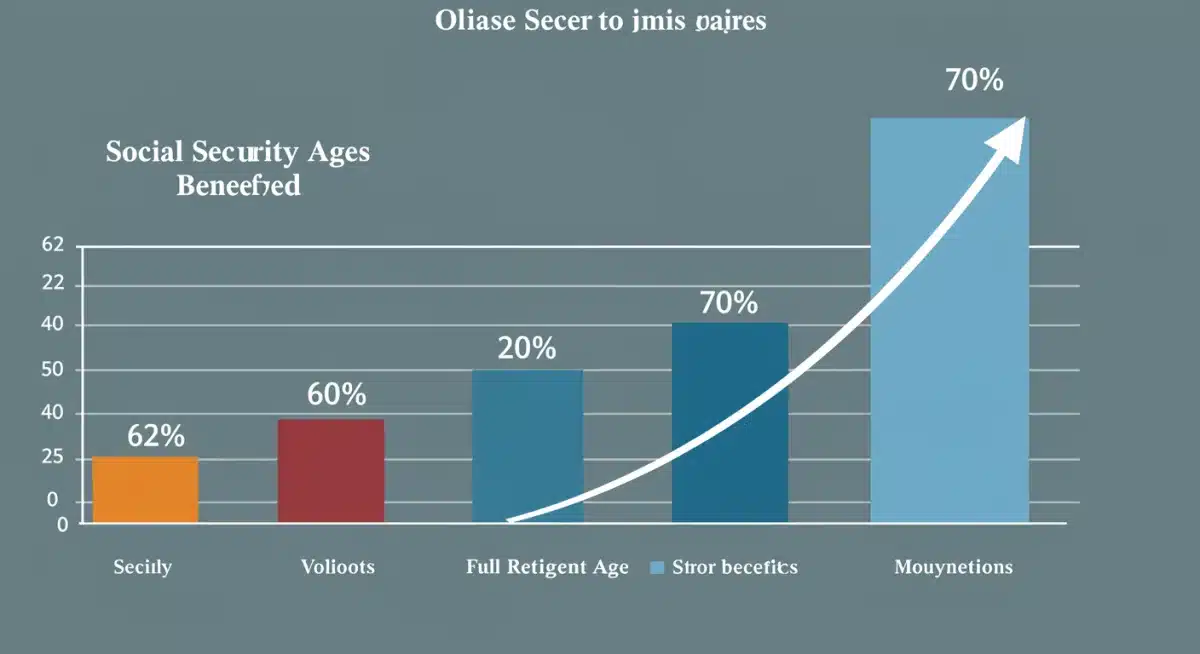
Claiming Social Security benefits early, as soon as age 62, can reduce your monthly payments by as much as 30%. Conversely, delaying benefits past your FRA, up to age 70, can increase your monthly payments by 8% for each year you delay, thanks to delayed retirement credits. This 8% annual increase is a powerful incentive for those who can afford to wait.
The decision to claim early or late is highly personal and depends on various factors, including your health, financial needs, and life expectancy. There’s no one-size-fits-all answer, making personalized planning crucial.
In conclusion, a solid understanding of Social Security basics, particularly your Full Retirement Age, is the bedrock of any successful benefits maximization strategy. This foundational knowledge empowers you to evaluate the trade-offs between early and delayed claiming, setting the stage for more advanced planning.
Strategy 1: Optimizing Your Claiming Age
The single most impactful decision you’ll make regarding Social Security is when to claim your benefits. While you can start as early as age 62, or as late as age 70, the optimal age depends heavily on your individual circumstances, health, and financial situation. This strategy explores how to make that critical choice.
Delaying benefits past your Full Retirement Age (FRA) is often the most recommended strategy for maximizing your lifetime benefits, assuming you have a reasonably long life expectancy. The delayed retirement credits offer a guaranteed 8% annual increase, a return rarely matched by other low-risk investments.
The power of delayed retirement credits
For each year you delay claiming benefits beyond your FRA, up to age 70, your monthly payment increases by a specific percentage. This increase is permanent and applies for the rest of your life. For someone with an FRA of 67, delaying until 70 means a 24% increase over their FRA benefit amount.
- Guaranteed 8% annual increase up to age 70.
- Permanent increase in monthly benefit.
- Acts as longevity insurance, protecting against outliving savings.
Considering your health and life expectancy
Your health and family history play a significant role in this decision. If you have a chronic health condition or a family history of shorter lifespans, claiming earlier might make more sense to ensure you receive benefits for a longer period. Conversely, if you’re in excellent health and expect to live well into your 80s or 90s, delaying can yield substantial financial rewards.
It’s a delicate balance between receiving benefits sooner and receiving higher benefits later. Financial modeling tools can help project total lifetime benefits under different claiming scenarios, providing a clearer picture.
Bridging the gap: working longer or using other assets
To enable a delayed claiming strategy, many individuals choose to work longer or rely on other retirement assets, such as 401(k)s or IRAs, to cover expenses until age 70. This approach allows your Social Security benefit to grow without needing to draw from it.
Optimizing your claiming age is not just about choosing a number; it’s about aligning that choice with your personal financial goals, health outlook, and overall retirement plan. It requires careful consideration and often, professional guidance.
Strategy 2: Understanding Spousal and Survivor Benefits
Social Security isn’t just about your own work record; it also provides significant benefits for spouses and survivors. Understanding these provisions can be a game-changer for married couples, potentially adding thousands of dollars to their household income in retirement. This strategy focuses on maximizing these often-overlooked benefits.
Spousal benefits allow an eligible spouse to receive up to 50% of their partner’s Full Retirement Age (FRA) benefit, even if they have little to no work history themselves. Survivor benefits, on the other hand, provide financial support to widows, widowers, and eligible children after a worker’s death.

Claiming spousal benefits strategically
A common strategy for married couples is for the lower-earning spouse to claim spousal benefits while the higher-earning spouse delays their own claim until age 70. This allows the household to receive some income while the higher earner’s benefit continues to grow.
- Spouses can claim benefits based on their partner’s record.
- Benefit amount is up to 50% of the primary earner’s FRA benefit.
- Can be claimed even if the other spouse has not yet claimed, under certain conditions.
Navigating survivor benefits
If your spouse passes away, you may be eligible for survivor benefits. The survivor benefit can be up to 100% of the deceased worker’s basic Social Security benefit. The age at which you claim these benefits significantly impacts the amount you receive.
It’s crucial for surviving spouses to understand their options, especially if they are also eligible for their own worker benefits. In some cases, it may be beneficial to claim one type of benefit first and switch to the other later.
The complexities of spousal and survivor benefits necessitate careful planning, especially for couples approaching retirement. These benefits are designed to protect families and can form a significant part of a comprehensive retirement income strategy.
Strategy 3: Working While Receiving Benefits and Taxation
Many individuals choose to work part-time or even full-time while receiving Social Security benefits. While this can provide additional income, it’s crucial to understand how earnings limits and taxation can impact your net benefits. This strategy explores the rules and smart approaches to working in retirement.
If you are below your Full Retirement Age (FRA) and work while receiving Social Security, your benefits may be reduced if your earnings exceed certain limits. Once you reach your FRA, these earnings limits no longer apply, and you can earn as much as you like without your benefits being reduced.
Earnings limits before full retirement age
For 2026, the specific earnings limits will be announced, but historically, if you are under FRA, the SSA deducts $1 from your benefits for every $2 you earn above a certain annual limit. In the year you reach FRA, the deduction rate is $1 for every $3 earned above a higher limit, but only for earnings before the month you reach FRA.
- Benefits can be temporarily reduced if earnings exceed limits.
- Once FRA is reached, earnings limits no longer apply.
- Reduced benefits are recalculated at FRA, potentially increasing future payments.
Understanding Social Security benefit taxation
Another critical aspect is the taxation of your Social Security benefits. Depending on your combined income (adjusted gross income + non-taxable interest + half of your Social Security benefits), a portion of your benefits may be subject to federal income tax.
Up to 85% of your Social Security benefits can be taxable. This often comes as a surprise to retirees who haven’t planned for it. Strategies like tax-efficient withdrawals from other retirement accounts can help manage your combined income and potentially reduce your Social Security tax liability.
Working in retirement can significantly boost your financial security, but it requires a thorough understanding of how your earnings might interact with Social Security benefits and tax rules. Proper planning can help you avoid unexpected reductions or tax burdens.
Strategy 4: Coordinating Benefits with Other Retirement Accounts
An effective retirement plan doesn’t view Social Security in isolation. Instead, it integrates your Social Security benefits with other retirement savings vehicles, such as 401(k)s, IRAs, and pensions. This coordinated approach can significantly enhance your overall retirement income and provide greater financial flexibility.
The goal is to create a diversified income stream that can withstand market fluctuations and unexpected expenses. By strategically drawing from different accounts at various times, you can optimize tax efficiency and ensure your money lasts throughout your retirement.
Strategic withdrawal order
One common strategy is to delay Social Security as long as possible, using funds from taxable accounts or tax-deferred accounts (like traditional IRAs or 401(k)s) to cover living expenses in the interim. This allows your Social Security benefits to grow, providing a larger, inflation-adjusted, and relatively stable income stream later in life.
- Use taxable accounts first to preserve tax-advantaged savings.
- Consider Roth conversions in lower-income years to reduce future tax burdens.
- Delay Social Security to maximize its guaranteed growth.
Managing required minimum distributions (RMDs)
Required Minimum Distributions (RMDs) from traditional IRAs and 401(k)s begin at age 73 (or 75 for those turning 74 after December 31, 2032). These distributions can increase your taxable income, potentially pushing more of your Social Security benefits into the taxable bracket.
Planning for RMDs is crucial. Strategies like qualified charitable distributions (QCDs) or Roth conversions can help manage your RMDs and their impact on your overall tax picture, thus indirectly helping to preserve more of your Social Security benefits.
Coordinating your Social Security benefits with your other retirement accounts is a sophisticated strategy that requires a holistic view of your finances. It’s about creating synergy between different income sources to achieve a more robust and tax-efficient retirement.
Strategy 5: Seeking Professional Advice and Staying Informed
The world of Social Security can be complex, with rules and regulations that change over time. While self-education is valuable, seeking professional advice from a qualified financial advisor specializing in retirement planning can provide personalized insights and ensure you’re making the best decisions for your unique situation. This final strategy emphasizes the importance of expert guidance and continuous learning.
A financial advisor can help you analyze your specific circumstances, project future benefits, and integrate Social Security into your broader financial plan. They can also help you navigate changes in Social Security law or economic conditions that might impact your benefits.
The value of a financial advisor
A good financial advisor will not only help you understand the intricacies of Social Security but also consider your entire financial picture, including investments, taxes, and estate planning. They can offer tailored strategies that maximize your benefits while aligning with your retirement goals.
- Personalized analysis of claiming options.
- Integration of Social Security with overall financial plan.
- Guidance on tax implications and withdrawal strategies.
Staying informed about rule changes
Social Security rules are not static; they can be influenced by legislation and economic factors. Staying informed about potential changes is crucial. Reputable financial news outlets, the Social Security Administration’s official website, and your financial advisor are excellent resources for updates.
For example, Cost-of-Living Adjustments (COLAs) are announced annually and directly impact your benefit amount. Understanding these adjustments and other potential policy changes ensures your strategy remains current and effective.
In sum, while these strategies provide a strong foundation, the complexities of Social Security and personal finance often warrant the expertise of a professional. Combining your own research with expert advice and a commitment to staying informed will put you in the best position to maximize your Social Security benefits.
| Key Strategy | Brief Description |
|---|---|
| Optimize Claiming Age | Delay benefits until age 70 for maximum delayed retirement credits, if health and finances permit. |
| Understand Spousal/Survivor Benefits | Leverage benefits for spouses and survivors to enhance household income and provide financial security. |
| Manage Work and Taxation | Be aware of earnings limits before FRA and the potential taxation of benefits to avoid surprises. |
| Coordinate Other Retirement Accounts | Integrate Social Security with 401(k)s, IRAs, and pensions for a comprehensive and tax-efficient income plan. |
Frequently Asked Questions About Social Security Benefits
You can claim Social Security retirement benefits as early as age 62. However, claiming at this age will result in a permanent reduction of your monthly benefit amount compared to what you would receive at your Full Retirement Age (FRA). The reduction can be up to 30%, depending on your birth year.
Delayed retirement credits increase your monthly Social Security benefit for each year you delay claiming past your Full Retirement Age (FRA), up to age 70. This increase is typically 8% per year. These credits are a powerful incentive to wait, as they provide a permanent boost to your lifetime benefits.
Yes, a portion of your Social Security benefits may be subject to federal income tax. The amount that is taxable depends on your ‘combined income,’ which includes your adjusted gross income, non-taxable interest, and half of your Social Security benefits. Up to 85% of your benefits could be taxed.
Spousal benefits allow an eligible spouse to receive benefits based on their partner’s work record. Generally, a spouse can receive up to 50% of the primary earner’s Full Retirement Age (FRA) benefit. This is particularly beneficial for spouses with lower earnings histories or who did not work outside the home.
Professional financial advice is crucial because Social Security rules are complex and constantly evolving. An advisor can provide personalized strategies based on your unique financial situation, health, and family dynamics, helping you integrate Social Security with other retirement assets and optimize your claiming decisions for maximum lifetime benefits.
Conclusion
Maximizing your Social Security benefits is more than just choosing a claiming age; it’s a strategic process that involves understanding complex rules, coordinating with other financial assets, and making informed decisions tailored to your personal circumstances. By diligently applying the five strategies discussed – optimizing your claiming age, leveraging spousal and survivor benefits, understanding the impact of working while receiving benefits and taxation, coordinating with other retirement accounts, and seeking professional advice – you can significantly enhance your financial security in retirement. The landscape of Social Security is dynamic, and proactive planning, coupled with continuous learning, is your best defense against potential pitfalls and your strongest asset for a comfortable and well-deserved retirement.

 2026 SNAP EBT Changes: Essential Guide for 3 Million Households
  Maximize Social Security: 5 Key Strategies for 2026 Payments