


The landscape of healthcare in the United States is constantly evolving, with significant changes often leading to widespread impacts on millions of lives. One of the most monumental shifts in recent years has been the ongoing Medicaid expansion benefits, a critical initiative that has opened doors to essential healthcare services for an estimated 15 million additional Americans. This expansion represents a pivotal moment in the nation’s commitment to accessible healthcare, aiming to reduce the number of uninsured individuals and alleviate the financial burden of medical care for low-income families and individuals. Understanding the intricacies of this expansion, who qualifies, and what it means for the future of healthcare is paramount for both beneficiaries and the broader public.
At its core, Medicaid is a joint federal and state program that provides health coverage to millions of Americans, including eligible low-income adults, children, pregnant women, elderly adults, and people with disabilities. The Affordable Care Act (ACA) of 2010 introduced the option for states to expand their Medicaid programs to cover nearly all non-elderly adults with incomes up to 138% of the federal poverty level (FPL). While not all states adopted this expansion immediately, a growing number have done so over the years, leading to the substantial increase in coverage we observe today. This blog post delves deep into the latest Medicaid expansion benefits, exploring its historical context, current impact, eligibility criteria, the benefits it offers, and how eligible individuals can navigate the application process. We will also examine the broader implications for public health and the economy, providing a comprehensive overview of this vital healthcare program.
The Genesis of Medicaid Expansion: A Brief History
To truly appreciate the significance of the latest Medicaid expansion benefits, it’s essential to understand its origins. Medicaid was established in 1965 alongside Medicare as part of President Lyndon B. Johnson’s Great Society initiatives. For decades, it primarily served specific categories of low-income individuals, such as pregnant women, children, and individuals with disabilities. However, a significant gap remained: many low-income adults without children or a disability were left without an affordable healthcare option, often falling into what became known as the ‘coverage gap’ – earning too much for Medicaid but too little for subsidies to afford private insurance.
The Affordable Care Act (ACA), signed into law in 2010, aimed to address this by mandating that states expand their Medicaid programs to cover all individuals with incomes up to 133% of the FPL (effectively 138% due to income disregard rules). This was a cornerstone of the ACA’s strategy to achieve near-universal health coverage. However, a 2012 Supreme Court ruling made this expansion optional for states, shifting the decision-making power from a federal mandate to individual state legislatures. This ruling led to a bifurcated system where some states expanded Medicaid immediately, while others opted out, citing concerns about costs and state autonomy.
Over the past decade, the trend has been towards expansion. Initially, a majority of states chose not to expand, but data demonstrating the positive impacts on health outcomes, financial stability for beneficiaries, and even state economies began to sway opinions. States that initially resisted eventually saw the benefits, including significant federal funding contributions (the federal government pays at least 90% of the costs for the newly eligible population). This gradual, state-by-state adoption is what has led to the current situation where 15 million more Americans now qualify for Medicaid expansion benefits, marking a substantial step towards a more inclusive healthcare system.
Who Qualifies Now? Understanding the New Eligibility Criteria
The expansion of Medicaid primarily targets low-income adults who previously did not fit into traditional Medicaid categories. Prior to the ACA, many states only covered adults if they had very low incomes and met specific criteria, such as being pregnant, a parent, elderly, or having a disability. The Medicaid expansion benefits significantly broadens this scope.
In states that have adopted the expansion, eligibility for adults aged 19-64 is generally based solely on income, without the need to meet additional categorical requirements. Specifically, individuals and families whose household income is at or below 138% of the Federal Poverty Level (FPL) are typically eligible. The FPL changes annually, so it’s crucial to check the most current guidelines. For example, in 2023, 138% of the FPL for a single individual was approximately $20,120 per year, and for a family of three, it was around $34,310 per year. These figures are illustrative and subject to change, so prospective applicants should always refer to official state Medicaid websites or resources.
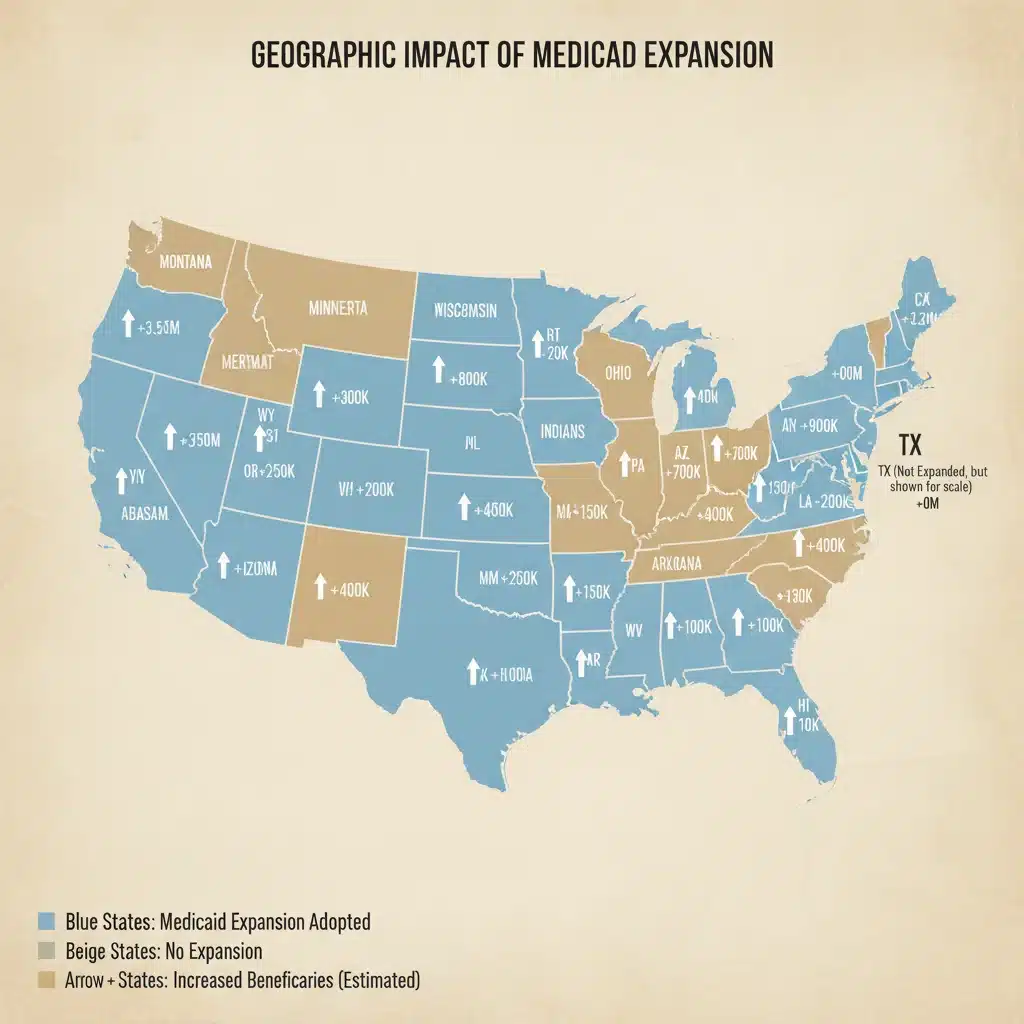
It’s important to note that eligibility also depends on the applicant’s state of residence. As of early 2024, 40 states and the District of Columbia have expanded Medicaid, while 10 states have not. This means that individuals in non-expansion states may still face the ‘coverage gap’ if their income is too high for traditional Medicaid but too low to qualify for ACA marketplace subsidies. Therefore, the first step for anyone considering applying for Medicaid expansion benefits is to confirm if their state has expanded its program.
Beyond income, other factors such as citizenship or legal residency status are also considered. Most applicants must be U.S. citizens or qualified non-citizens (e.g., permanent residents, refugees). There are also specific rules for certain populations, such as pregnant women and children, who may qualify under different, often higher, income thresholds regardless of expansion status. The expansion primarily impacts the coverage of non-elderly, non-disabled adults who previously had limited options.
The Comprehensive Benefits Package: What Medicaid Expansion Offers
For those who qualify, the Medicaid expansion benefits package is comprehensive, covering a wide array of essential health services. Unlike some private insurance plans with high deductibles and co-pays, Medicaid generally offers low or no out-of-pocket costs, making healthcare truly affordable for those who need it most. The specific services covered can vary slightly by state, but federal law mandates a core set of benefits.
Key services typically covered under Medicaid expansion include:
- Doctor Visits: Routine check-ups, specialist consultations, and urgent care.
- Hospital Services: Inpatient and outpatient hospital care, including emergency services.
- Prescription Drugs: Coverage for necessary medications, often with minimal or no co-pay.
- Mental Health Services: Counseling, therapy, and psychiatric care, addressing a critical need.
- Substance Use Disorder Treatment: Comprehensive services for addiction recovery, including medication-assisted treatment.
- Maternity and Newborn Care: Prenatal care, delivery services, and postnatal care for mothers and infants.
- Preventive Services: Vaccinations, screenings (e.g., cancer screenings), and health education.
- Laboratory and X-ray Services: Diagnostic tests to identify and monitor health conditions.
- Rehabilitative Services: Physical therapy, occupational therapy, and speech therapy.
- Transportation: In some cases, assistance with transportation to medical appointments.
The breadth of these Medicaid expansion benefits means that individuals who were previously uninsured or underinsured can now access a full spectrum of care, from preventive services that keep them healthy to critical treatments for chronic conditions or acute illnesses. This not only improves individual health outcomes but also reduces the strain on emergency rooms, which often serve as a last resort for the uninsured, leading to more efficient use of healthcare resources overall.
Furthermore, the expansion has been shown to reduce medical debt and improve financial stability for low-income households. Without the burden of exorbitant medical bills, individuals can allocate their resources to other necessities, contributing to overall economic well-being. The comprehensive nature of the benefits package ensures that beneficiaries receive timely and appropriate care, leading to earlier diagnosis and treatment, and ultimately, a healthier population.
The Application Process: How to Access Medicaid Expansion Benefits
Applying for Medicaid expansion benefits is designed to be as straightforward as possible, though the exact process can vary slightly from state to state. The primary avenues for application are through the Health Insurance Marketplace (Healthcare.gov) or directly through your state’s Medicaid agency.
Applying via the Health Insurance Marketplace:
The most common way to apply is by visiting Healthcare.gov (or your state’s equivalent marketplace website if it operates its own). When you fill out an application for health insurance on the Marketplace, the system automatically assesses your eligibility for Medicaid based on your income and household information. If you qualify for Medicaid in your state, your application will be securely transferred to your state’s Medicaid agency for further processing. This integrated approach simplifies the process, as you don’t need to know beforehand whether you qualify for marketplace subsidies or Medicaid.
Applying Directly through Your State’s Medicaid Agency:
You can also apply directly through your state’s Medicaid website or by contacting your local Medicaid office. Most states offer online applications, downloadable forms, or phone assistance. This method can be particularly useful if you are confident you meet the Medicaid eligibility criteria and wish to bypass the broader marketplace application. Search for "[Your State Name] Medicaid" to find the official website and application portal.
Required Documentation:
Regardless of the application method, you will typically need to provide information and documentation to verify your identity, income, household size, and residency. This may include:
- Proof of identity (e.g., driver’s license, state ID)
- Proof of citizenship or immigration status (e.g., birth certificate, passport, green card)
- Proof of income (e.g., pay stubs, tax returns, employer statements)
- Social Security numbers for all household members applying
- Information about other health insurance you may have (if any)
It’s advisable to gather these documents before starting your application to ensure a smooth and quick process. Many states also offer assistance from navigators or assisters who can provide free, unbiased help with the application process, answering questions and ensuring all necessary information is submitted correctly.

The Impact of Medicaid Expansion: Beyond Individual Health
The impact of Medicaid expansion benefits extends far beyond the individual beneficiaries, creating a ripple effect across public health, state economies, and the healthcare system as a whole.
Improved Health Outcomes:
Numerous studies have consistently shown that Medicaid expansion leads to significant improvements in health outcomes. Expanded access to primary care, preventive services, and chronic disease management results in earlier diagnosis and treatment of conditions, better control of chronic illnesses like diabetes and hypertension, and a reduction in preventable hospitalizations. For instance, research has indicated a decrease in mortality rates among adults in expansion states compared to non-expansion states. This is particularly true for conditions that are highly treatable with timely medical intervention.
Financial Protection and Economic Benefits:
The financial protection offered by Medicaid is profound. It dramatically reduces medical debt, which is a leading cause of bankruptcy in the U.S. Families no longer have to choose between paying for essential healthcare and other critical needs like food or housing. From an economic perspective, expansion brings substantial federal dollars into states, boosting local economies through increased healthcare spending and job creation in the healthcare sector. Hospitals in expansion states also report reductions in uncompensated care costs, improving their financial stability and allowing them to invest more in patient services and infrastructure.
Addressing Health Disparities:
Medicaid expansion has played a crucial role in reducing health disparities, particularly among racial and ethnic minority groups who are disproportionately affected by lack of insurance coverage. By providing access to care for these vulnerable populations, the expansion helps to level the playing field, ensuring that everyone has a more equitable opportunity to achieve good health, regardless of their socioeconomic status or background.
Strengthening the Healthcare Safety Net:
The expansion strengthens the overall healthcare safety net by ensuring that more people have a designated source of primary care rather than relying on emergency rooms for routine health issues. This allows emergency departments to focus on true emergencies, improving efficiency and reducing wait times for all patients. It also supports community health centers and other safety-net providers, enabling them to serve a larger insured population.
Challenges and Future Outlook of Medicaid Expansion
Despite its many successes, the Medicaid expansion benefits program is not without its challenges. The primary obstacle remains the states that have yet to expand. The ‘coverage gap’ persists in these states, leaving millions of low-income adults without affordable healthcare options. Advocacy efforts continue in these non-expansion states, with many seeing ongoing debates and ballot initiatives aimed at bringing expansion to their residents.
Another challenge lies in ensuring that eligible individuals are aware of their eligibility and successfully enroll. Despite widespread coverage, many who qualify may not know about the program or may face barriers to application, such as lack of internet access or difficulty navigating complex forms. Outreach and enrollment assistance programs are vital in overcoming these hurdles.
Looking ahead, the future of Medicaid expansion will likely involve continued efforts to bring all states on board. The economic and health benefits are becoming increasingly difficult for non-expansion states to ignore. Furthermore, as the program matures, there may be ongoing discussions about program efficiency, integration with other health services, and adapting to the evolving healthcare needs of the population. The recent public health emergency highlighted the critical role of Medicaid in providing a safety net during times of crisis, further solidifying its importance.
Policy discussions may also focus on how to sustain the program and ensure its long-term viability, particularly regarding federal-state funding mechanisms. As technology advances, there’s also potential for streamlining enrollment and access to care through digital platforms and telehealth services, further enhancing the reach and effectiveness of Medicaid expansion benefits.
Conclusion: A Healthier Future with Medicaid Expansion
The expansion of Medicaid has been a transformative force in American healthcare, extending vital Medicaid expansion benefits to millions who previously lacked access. The addition of 15 million Americans to the Medicaid rolls represents not just a statistic, but countless individual stories of improved health, financial security, and peace of mind. By allowing states to cover nearly all low-income adults, the program has made significant strides in reducing the uninsured rate, improving public health outcomes, and strengthening the overall healthcare system.
For individuals and families, understanding the eligibility criteria and knowing how to apply for Medicaid expansion benefits is a crucial step towards securing essential healthcare. For states, the decision to expand has proven to be a sound investment, bringing federal funds, reducing uncompensated care, and fostering a healthier workforce. While challenges remain, the undeniable positive impact of Medicaid expansion underscores its importance as a cornerstone of the nation’s efforts to ensure that every American has access to the healthcare they need and deserve. As more states consider joining the expansion, the vision of a truly universal and equitable healthcare system moves closer to reality, promising a healthier and more secure future for millions.

 2026 SNAP EBT Changes: Essential Guide for 3 Million Households
  Maximize Social Security: 5 Key Strategies for 2026 Payments