
Federal Student Loan Repayment Guide for 2026 Graduates

Anúncios
Understanding Your Federal Student Loan Repayment Options: A Guide for 2026 Graduates
Congratulations, Class of 2026! As you prepare to embark on the next chapter of your lives, whether it’s entering the workforce, pursuing further education, or exploring new opportunities, one significant aspect of your financial future will likely involve managing your federal student loans. The landscape of student loan repayment 2026 can seem daunting, filled with acronyms, deadlines, and various plans. However, with the right information and a proactive approach, you can navigate these waters successfully.
Anúncios
This comprehensive guide is designed specifically for 2026 graduates, providing a clear, concise, and actionable overview of your federal student loan repayment options. We’ll break down the different plans available, discuss key considerations, and offer strategies to help you make informed decisions that align with your financial goals. Understanding your choices now will empower you to build a strong financial foundation for years to come.
The Basics of Federal Student Loan Repayment for 2026 Graduates
Before diving into specific repayment plans, it’s crucial to understand the fundamental aspects of your federal student loans. Most federal student loans come with a grace period, typically six months after you graduate, leave school, or drop below half-time enrollment. During this period, you are generally not required to make payments. However, interest may accrue on unsubsidized loans during this time, which will be capitalized (added to your principal balance) at the end of the grace period.
Anúncios
Who is Your Loan Servicer?
Your loan servicer is the company that handles the billing and other services for your federal student loans. They are your primary point of contact for questions about your loan balance, payment due dates, and repayment options. It’s essential to identify your loan servicer early on. You can find this information by logging into your Federal Student Aid (FSA) account on studentaid.gov. Make sure your contact information is up-to-date with both FSA and your loan servicer.
Understanding Interest Rates and Accrual
Federal student loans come with fixed interest rates, meaning the rate won’t change over the life of the loan. However, understanding how interest accrues is vital. For unsubsidized loans, interest begins accruing immediately after disbursement. For subsidized loans, the government generally pays the interest while you’re in school at least half-time, during your grace period, and during periods of deferment. Knowing your interest rates will help you prioritize which loans to pay down faster if you choose to make extra payments.
Standard Repayment Plans: The Default Path
For many graduates, the default repayment plan is the Standard Repayment Plan. This plan typically involves fixed monthly payments over a 10-year period (or up to 30 years for consolidated loans). It’s designed to ensure your loans are paid off within a decade, leading to the lowest total interest paid over the life of the loan compared to other plans.
Is the Standard Plan Right for You?
The Standard Repayment Plan is an excellent choice if you have a stable income that allows you to comfortably afford the fixed monthly payments. It offers predictability and minimizes the total cost of your loan. However, if your initial post-graduation income is modest or uncertain, these payments might be challenging. It’s crucial to assess your budget and income projections carefully before committing to this plan.
Income-Driven Repayment (IDR) Plans: Flexibility for Your Budget
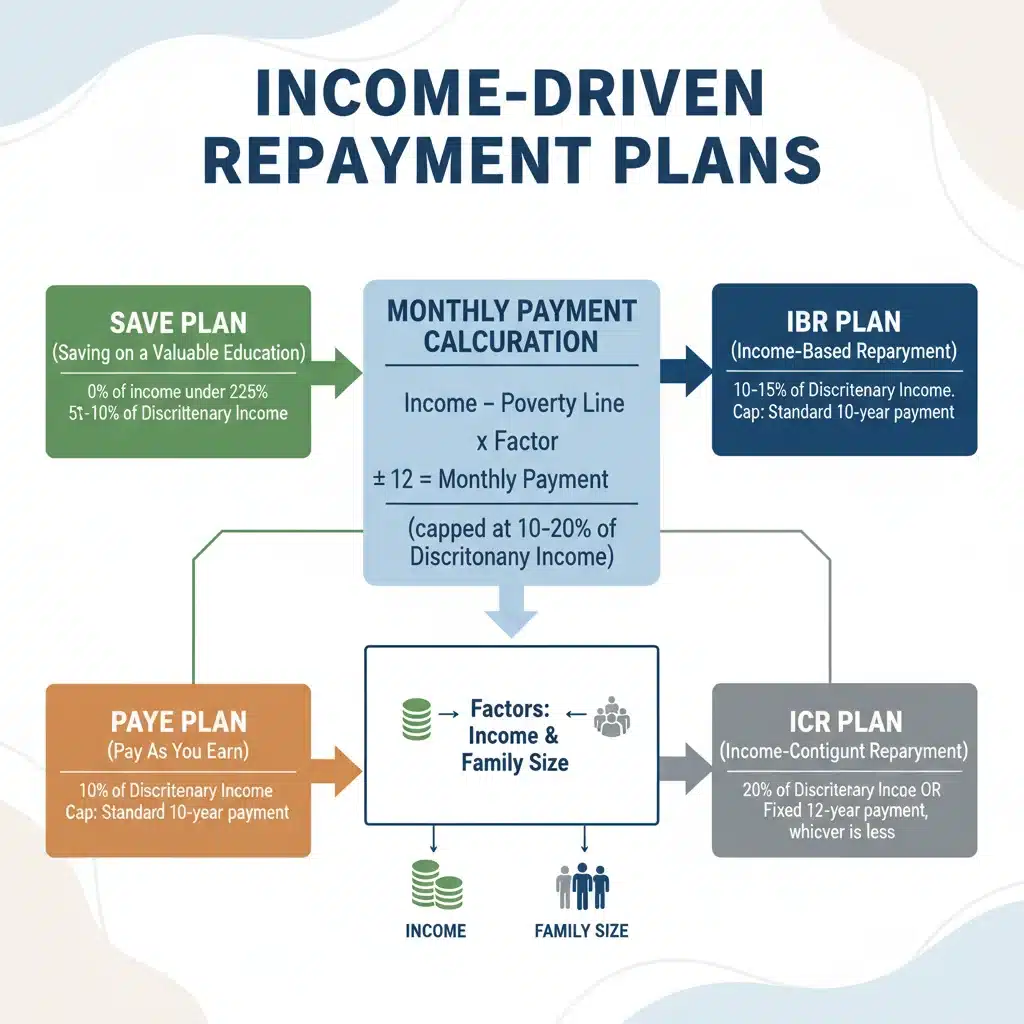
Federal student loan programs offer several Income-Driven Repayment (IDR) plans, which are designed to make your monthly loan payments affordable based on your income and family size. These plans typically extend the repayment period to 20 or 25 years, and any remaining balance after that period may be forgiven. IDR plans are a lifeline for many 2026 graduates who might be starting their careers with lower salaries.
Key IDR Plans to Consider:
- SAVE Plan (Saving on a Valuable Education): This is the newest and often most beneficial IDR plan, especially for borrowers with lower incomes. The SAVE Plan replaces the REPAYE Plan and offers significant advantages, including a payment calculation that protects more of your income from being counted towards your payment. For undergraduate loans, monthly payments are typically 5% of your discretionary income (which is calculated differently than other IDR plans, protecting more of your income). Crucially, if your calculated payment doesn’t cover the monthly interest, the government covers the remaining interest, preventing your balance from growing due to unpaid interest.
- Pay As You Earn (PAYE) Repayment Plan: Monthly payments are generally 10% of your discretionary income, but never more than what you would pay under the 10-year Standard Repayment Plan. The repayment period is 20 years.
- Income-Based Repayment (IBR) Plan: Monthly payments are generally 10% or 15% of your discretionary income, depending on when you received your first loans, but never more than what you would pay under the 10-year Standard Repayment Plan. The repayment period is 20 or 25 years.
- Income-Contingent Repayment (ICR) Plan: Monthly payments are either 20% of your discretionary income or what you would pay on a fixed 12-year repayment plan adjusted for your income, whichever is less. The repayment period is 25 years.
How Discretionary Income is Calculated for IDR Plans
For most IDR plans (PAYE, IBR, ICR), discretionary income is the difference between your adjusted gross income (AGI) and 150% of the poverty guideline for your family size and state of residence. The SAVE Plan offers a more generous calculation, typically using 225% of the poverty guideline for undergraduate loans, meaning more of your income is protected and your payments could be lower.
Annual Recertification for IDR Plans
If you enroll in an IDR plan, you must recertify your income and family size annually. This ensures your monthly payments remain appropriate for your current financial situation. Failing to recertify can lead to your payments reverting to the Standard Repayment Plan amount, and any unpaid interest may be capitalized.
Loan Consolidation: Streamlining Your Debt
Federal Direct Loan Consolidation allows you to combine multiple federal student loans into a single new loan with one servicer and one monthly payment. The interest rate for a Direct Consolidation Loan is the weighted average of the interest rates on the loans being consolidated, rounded up to the nearest one-eighth of a percentage point.
Benefits of Consolidation:
- Simplicity: One payment to one servicer simplifies your financial management.
- Access to More IDR Plans: Consolidating certain older federal loans (like FFEL Program loans) can make them eligible for IDR plans they wouldn’t otherwise qualify for, such as the SAVE Plan.
- Extended Repayment Period: Consolidation can extend your repayment period up to 30 years, lowering your monthly payment, though it will likely increase the total interest paid over the life of the loan.
Considerations Before Consolidating:
- Loss of Borrower Benefits: You might lose certain benefits associated with your original loans, such as interest rate discounts or principal rebates.
- Starting Over on Forgiveness: If you’ve already made qualifying payments towards Public Service Loan Forgiveness (PSLF) or IDR forgiveness, consolidating typically resets your payment count to zero. However, under recent temporary changes, some borrowers may retain credit for past payments. Always check the latest guidelines on studentaid.gov.
Public Service Loan Forgiveness (PSLF): For Those Who Serve
The Public Service Loan Forgiveness (PSLF) Program is a lifeline for graduates who dedicate their careers to public service. If you work full-time for a qualifying government or non-profit organization, you may be eligible to have the remaining balance of your Direct Loans forgiven after making 120 qualifying monthly payments under a qualifying repayment plan.
Key Requirements for PSLF:
- Eligible Loans: Only Direct Loans qualify. If you have FFEL Program loans or Perkins Loans, you’ll need to consolidate them into a Direct Consolidation Loan to be eligible.
- Eligible Employment: Work full-time for a U.S. federal, state, local, or tribal government agency, or a not-for-profit organization that is tax-exempt under Section 501(c)(3) of the Internal Revenue Code.
- Qualifying Payments: Make 120 on-time, full monthly payments under a qualifying repayment plan (typically an IDR plan). Payments do not need to be consecutive.
It’s highly recommended to submit the PSLF Employment Certification Form regularly (annually or whenever you change employers) to track your progress and ensure your employment and loans qualify. This is crucial for 2026 graduates considering public service careers.
Deferment and Forbearance: Temporary Relief
If you’re facing financial hardship, you might be able to temporarily postpone your student loan payments through deferment or forbearance. These options can provide much-needed breathing room, but it’s important to understand their implications.
Deferment:
During deferment, you temporarily postpone your loan payments. For subsidized loans, the government pays the interest that accrues during deferment. For unsubsidized loans, you are responsible for the interest that accrues, and if you don’t pay it, it will be capitalized.
Common types of deferment include:
- In-School Deferment: If you return to school at least half-time.
- Unemployment Deferment: If you’re looking for full-time employment (up to three years).
- Economic Hardship Deferment: If you’re experiencing economic hardship (up to three years).
Forbearance:
Forbearance also allows you to temporarily stop or reduce your monthly payments. However, interest accrues on all types of federal loans (subsidized and unsubsidized) during forbearance, and this interest will be capitalized if not paid. Forbearance is typically granted for shorter periods (12 months at a time, up to three years total) and is often easier to obtain than deferment.
While deferment and forbearance can provide relief, they should be used cautiously. Interest accrual can significantly increase your total loan cost over time, and capitalized interest can lead to a larger principal balance.
Strategic Repayment Tips for 2026 Graduates
Beyond understanding the available plans, implementing smart strategies can significantly impact your student loan journey.
1. Create a Detailed Budget
One of the most fundamental steps is to create a realistic budget that accounts for all your income and expenses. This will help you determine how much you can comfortably afford to pay towards your loans each month. Understanding your cash flow is critical for making informed decisions about your student loan repayment 2026.
2. Understand Your Loan Details
Know the interest rate, principal balance, and type of each of your federal loans. This information can be found on studentaid.gov and through your loan servicer. Prioritize paying down loans with higher interest rates if you can afford to make extra payments.
3. Choose the Right Repayment Plan
Don’t just stick with the default Standard Repayment Plan if it doesn’t fit your financial situation. Explore all IDR options, especially the SAVE Plan, to find the one that offers the most manageable payments while working towards your long-term goals. Use the Loan Simulator tool on studentaid.gov to compare different plans.
4. Make Payments Even During Grace Periods (If Possible)
If you have unsubsidized loans, interest accrues during your grace period. Making interest-only payments during this time can prevent that interest from capitalizing and increasing your principal balance.
5. Explore Employer Benefits
Some employers offer student loan repayment assistance as part of their benefits package. Inquire with your HR department about any such programs. This can be a valuable perk that significantly reduces your debt burden.
6. Consider Refinancing Private Loans (If Applicable)
While this guide focuses on federal loans, if you also have private student loans, consider refinancing them if you can get a lower interest rate. Be aware that refinancing federal loans into a private loan means losing federal protections like IDR plans, deferment, and forbearance options.
7. Stay in Communication with Your Loan Servicer
If you anticipate difficulty making payments, contact your loan servicer immediately. They can discuss your options, such as changing repayment plans, deferment, or forbearance, before you miss a payment and potentially damage your credit.

8. Automate Your Payments
Setting up automatic payments can help you avoid missing due dates and may even qualify you for a small interest rate reduction (typically 0.25%). This ensures consistent payments and helps maintain a good credit history.
9. Understand Tax Implications
Student loan interest payments may be tax-deductible, up to a certain amount. Additionally, any forgiven loan balance under IDR plans (after 20 or 25 years) may be considered taxable income, though there have been temporary waivers for this. Consult a tax professional for personalized advice.
The Future of Student Loan Repayment and How it Affects 2026 Graduates
The landscape of federal student loan repayment is dynamic, with policy changes and new initiatives frequently emerging. For 2026 graduates, it’s essential to stay informed about any future developments that could impact your loans.
The SAVE Plan’s Continued Evolution
The SAVE Plan, which fully launched in 2024, is expected to continue to be a cornerstone of federal student loan repayment. Further enhancements are anticipated, particularly regarding the payment calculation for undergraduate loans potentially dropping to 5% of discretionary income and faster forgiveness for smaller loan balances. Keep an eye on official announcements from the Department of Education.
Potential for Further Loan Forgiveness Initiatives
While broad-based student loan forgiveness has faced legal challenges, targeted forgiveness programs (like PSLF or specific IDR adjustments) may continue to be implemented or expanded. Staying updated through official channels like studentaid.gov is crucial.
The Importance of Financial Literacy
More than ever, financial literacy is paramount. Understanding your debt, your income, and your spending habits will be the most powerful tools in your arsenal as you navigate student loan repayment 2026 and beyond. Seek out reliable resources, attend webinars, and don’t hesitate to ask for help from financial advisors or your loan servicer.
Conclusion: Empowering Your Financial Journey
As you step into your post-graduation life, remember that managing your federal student loans is a marathon, not a sprint. By understanding your options, particularly the nuances of student loan repayment 2026, you can make choices that set you up for financial success. Take the time to research, plan, and communicate with your loan servicer. You have a range of tools at your disposal, from standard plans to flexible IDR options like the SAVE Plan, and even pathways to forgiveness through PSLF.
Your journey as a 2026 graduate is just beginning, and with careful financial planning, you can tackle your student loan debt with confidence and build a secure future. Don’t let the complexity deter you; instead, use this guide as your starting point to take control of your student loan repayment and thrive.
