
ACA Subsidies 2026: Unlock Up to $400 Monthly Premium Reductions

Anúncios
Understanding and leveraging the Affordable Care Act (ACA) subsidies for 2026 can be a game-changer for countless Americans seeking affordable health insurance. With the potential to secure up to $400 in monthly premium reductions, these subsidies make quality healthcare accessible and manageable. This comprehensive guide will walk you through everything you need to know about ACA subsidies 2026, from eligibility requirements to the application process, ensuring you are well-equipped to maximize your savings and secure the best possible health coverage for yourself and your family.
The healthcare landscape can often seem daunting, with rising costs and complex terminology. However, the ACA, often referred to as Obamacare, was designed to alleviate some of these burdens by providing financial assistance to eligible individuals and families. As we look towards 2026, it’s crucial to understand how these subsidies work and what changes, if any, might impact your benefits. Our focus here is to demystify the process and provide actionable insights so you can confidently navigate the Health Insurance Marketplace.
Anúncios
What Are ACA Subsidies and Why Are They Important for 2026?
At its core, an ACA subsidy is financial assistance from the government designed to lower the cost of health insurance premiums and out-of-pocket expenses for eligible individuals and families. These subsidies come in two main forms: Premium Tax Credits (PTCs) and Cost-Sharing Reductions (CSRs). For 2026, these subsidies continue to play a vital role in making health insurance affordable, especially given ongoing economic considerations and healthcare costs.
Premium Tax Credits (PTCs) directly reduce your monthly health insurance premium. When you apply for coverage through the Health Insurance Marketplace, you can choose to have these credits paid directly to your insurance company, lowering your monthly bill. Alternatively, you can claim the full credit when you file your federal income taxes. The amount of your PTC is primarily based on your household income and family size, compared to the federal poverty level (FPL). The beauty of PTCs is their flexibility; they adjust to your income, meaning if your income decreases, your subsidy might increase, ensuring your premiums remain affordable.
Anúncios
Cost-Sharing Reductions (CSRs), on the other hand, help lower your out-of-pocket costs, such as deductibles, copayments, and coinsurance. These reductions are only available if you enroll in a Silver-level plan through the Marketplace and meet specific income criteria. CSRs effectively make your Silver plan more robust, offering benefits similar to a Gold or Platinum plan at a lower premium. It’s important to note that while PTCs are available to a broader income range, CSRs are targeted at those with lower incomes to provide more substantial financial protection against healthcare expenses.
The importance of ACA subsidies 2026 cannot be overstated. Without them, millions of Americans would find health insurance prohibitively expensive, leading to higher rates of uninsured individuals and potential financial catastrophe in the event of illness or injury. By effectively capping the percentage of income individuals and families must pay for premiums, these subsidies ensure that healthcare remains within reach, fostering a healthier and more financially secure population.
Who is Eligible for ACA Subsidies in 2026?
Eligibility for ACA subsidies 2026 primarily hinges on your household income relative to the Federal Poverty Level (FPL), your family size, and whether you have access to other affordable health coverage. There are a few key criteria to keep in mind:
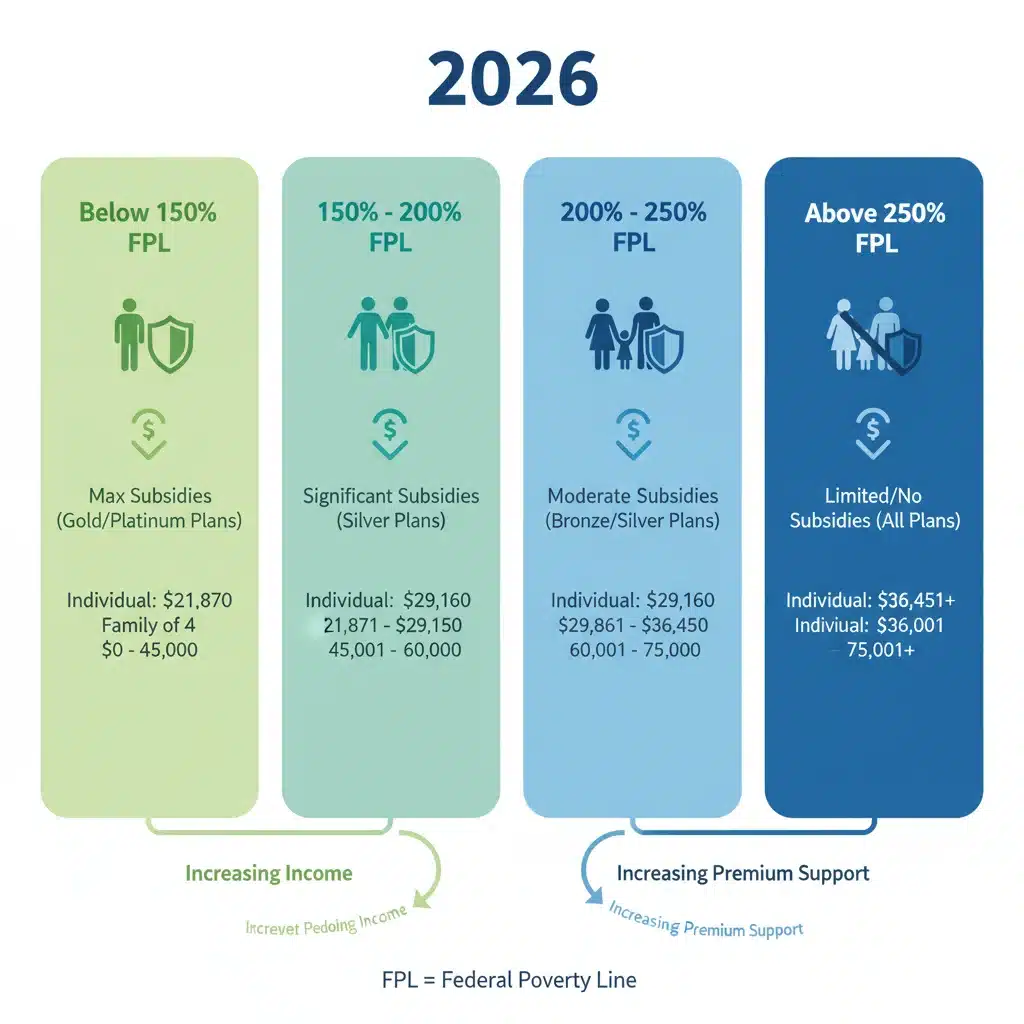
- Income Requirements: Historically, premium tax credits were available to individuals and families with incomes between 100% and 400% of the FPL. However, temporary enhancements made permanent by recent legislation have expanded eligibility, removing the upper income limit for subsidy eligibility. This means that even if your income is above 400% FPL, you might still qualify for a subsidy if your benchmark plan premium exceeds 8.5% of your household income. This is a significant change, making more people eligible for financial assistance.
- Not Offered Affordable Employer Coverage: You generally won’t qualify for subsidies if you have access to affordable health insurance through your employer or your spouse’s employer. Employer-sponsored coverage is considered affordable if the employee’s share of the premium for self-only coverage is less than a certain percentage (which adjusts annually) of your household income. If the employer plan is deemed unaffordable or doesn’t provide minimum value, you might still be eligible for subsidies through the Marketplace.
- Not Eligible for Government Programs: You cannot be eligible for Medicare, Medicaid, or CHIP (Children’s Health Insurance Program) to qualify for ACA subsidies. These government programs offer their own forms of affordable healthcare.
- Residency and Citizenship: You must be a U.S. citizen or lawfully present immigrant and reside in the United States.
It’s crucial to estimate your household income accurately for the year you need coverage (in this case, 2026). The Marketplace uses this projection to determine your subsidy amount. If your actual income differs significantly from your estimate, you might owe money back to the IRS or receive a larger refund when you file your taxes. Therefore, it’s always recommended to update your income information with the Marketplace if your financial situation changes throughout the year.
How Much Can You Save? Up to $400 in Monthly Premium Reductions
The prospect of saving up to $400 or more per month on health insurance premiums is a powerful motivator for exploring ACA subsidies 2026. The exact amount of your subsidy depends on several factors, primarily your household income, family size, and the cost of the benchmark plan in your area.
The benchmark plan is the second-lowest cost Silver plan available in your specific service area. The subsidy is calculated to ensure that your premium for this benchmark plan does not exceed a certain percentage of your household income, based on a sliding scale. With the enhanced subsidies, this percentage is significantly lower, leading to greater savings for many.
For example, a family of four with a moderate income might find their benchmark plan premium reduced by several hundred dollars each month. An individual with a lower income could see their premium drop to a very minimal amount, sometimes even $0, depending on their specific circumstances and location. The $400 figure is an illustrative example of the substantial savings many individuals and families can achieve, particularly those who previously found Marketplace plans too expensive.
It’s important to remember that while the subsidy is calculated based on the benchmark Silver plan, you are not required to enroll in that specific plan. You can use your Premium Tax Credit to purchase any Bronze, Silver, Gold, or Platinum plan offered on the Marketplace. If you choose a plan that costs less than the benchmark plan, your subsidy might cover the entire premium. If you choose a more expensive plan, you would pay the difference after the subsidy is applied.

The Application Process: Securing Your ACA Subsidies for 2026
Applying for ACA subsidies 2026 and enrolling in a health plan through the Health Insurance Marketplace is a straightforward process, typically conducted during the annual Open Enrollment Period. While specific dates for the 2026 Open Enrollment will be announced later, it generally runs from November 1st to December 15th of the preceding year, with coverage starting January 1st.
Step-by-Step Application Guide:
- Visit HealthCare.gov: This is the official federal Health Insurance Marketplace website. If your state runs its own Marketplace, you will be redirected to your state’s specific website.
- Create an Account: You’ll need to create an account with a username and password.
- Provide Personal and Household Information: This includes details about yourself, your family members (if applicable), their ages, addresses, and social security numbers.
- Estimate Your 2026 Income: This is a crucial step. Provide an honest and accurate estimate of your Modified Adjusted Gross Income (MAGI) for the upcoming year. Include all sources of income for every household member who is required to file taxes. Be prepared to update this information if your income changes significantly during 2026.
- Answer Questions About Other Coverage: The Marketplace will ask if you or anyone in your household has access to affordable employer-sponsored coverage or is eligible for Medicare, Medicaid, or CHIP.
- Review Eligibility and Plan Options: Based on the information you provide, the Marketplace will determine your eligibility for ACA subsidies 2026 (Premium Tax Credits and Cost-Sharing Reductions) and display available health plans in your area.
- Compare Plans: Carefully compare different plans based on premiums, deductibles, copayments, coinsurance, provider networks, and covered benefits. Pay attention to the metal tiers (Bronze, Silver, Gold, Platinum) as they indicate the level of cost-sharing. Remember, CSRs are only available with Silver plans.
- Choose Your Plan and Enroll: Once you’ve selected a plan, you can enroll directly through the Marketplace. You’ll then decide how you want to receive your Premium Tax Credit – either applied directly to your monthly premium or claimed at tax time.
- Make Your First Premium Payment: Your coverage typically begins after your first premium payment is made to the insurance company.
Important Considerations:
- Open Enrollment: This is the primary time to enroll or change plans. Missing it means you might have to wait until the next year unless you qualify for a Special Enrollment Period (SEP).
- Special Enrollment Periods (SEPs): Certain life events, such as getting married, having a baby, losing other health coverage, or moving, can trigger an SEP, allowing you to enroll outside of Open Enrollment.
- Documentation: Be prepared to provide documentation to verify your income, citizenship, and other information if requested by the Marketplace.
Maximizing Your Savings with ACA Subsidies in 2026
To truly get the most out of ACA subsidies 2026, a strategic approach is necessary. It’s not just about applying; it’s about making informed choices.
- Accurate Income Estimation: This is paramount. Overestimate, and you might receive less subsidy than you’re entitled to. Underestimate, and you could owe money back to the IRS. Use pay stubs, tax returns from previous years, and any anticipated changes in income (promotions, job changes, retirement) to make the most accurate projection possible.
- Consider Silver Plans for CSRs: If your income qualifies you for Cost-Sharing Reductions (generally up to 250% FPL), always choose a Silver plan. This is the only metal tier that allows you to benefit from CSRs, significantly lowering your deductibles, copayments, and out-of-pocket maximums. A subsidized Silver plan can often offer better value than a Gold plan for those eligible for CSRs.
- Compare Across Metal Tiers: Don’t just look at the premium. A Bronze plan might have a low premium but a very high deductible, making it less suitable if you anticipate needing medical care. A Gold plan might have a higher premium but lower out-of-pocket costs. Use your subsidy to make a higher-tier plan more affordable.
- Utilize the Marketplace Tools: The Health Insurance Marketplace website (HealthCare.gov or your state’s exchange) provides comparison tools that allow you to filter plans, see estimated out-of-pocket costs, and check if your doctors are in network.
- Seek Assistance from Navigators or Assisters: These are free, unbiased resources available to help you understand your options, estimate income, and complete the application process. They are certified by the Marketplace and can provide invaluable personalized guidance.
- Update Your Information: If your income or household size changes during 2026, report it to the Marketplace immediately. This ensures your subsidy amount is adjusted accordingly, preventing surprises at tax time.
Potential Changes and What to Watch For in 2026
While the enhanced ACA subsidies 2026 are currently set to continue, the political and economic landscape can always bring potential changes. It’s wise to stay informed about any legislative developments that could impact the Affordable Care Act and its financial assistance programs.
- Legislative Stability: The current enhanced subsidies, which remove the income cap for eligibility and increase the generosity of the tax credits, were made permanent by the Inflation Reduction Act. This provides a degree of stability for 2026 and beyond, but future administrations or Congresses could always introduce new legislation.
- Inflation and Cost of Living: The Federal Poverty Level (FPL) and other income thresholds are updated annually to account for inflation. This means that the income brackets for subsidy eligibility will likely be adjusted for 2026, which could slightly shift who qualifies and for how much.
- Benchmark Plan Costs: The cost of the benchmark Silver plan in your area can fluctuate each year based on local market dynamics, competition among insurers, and healthcare cost trends. These changes directly impact the amount of your subsidy, as the subsidy is designed to cap your premium relative to this benchmark.
- State-Specific Rules: Some states have expanded Medicaid under the ACA, which affects eligibility for Marketplace subsidies for individuals below 138% of the FPL. Other states might have their own programs or rules that interact with federal subsidies. Always check your state’s specific Health Insurance Marketplace information.
Staying updated by checking official sources like HealthCare.gov, reputable news outlets, and your state’s insurance department will ensure you’re aware of any pertinent changes that could affect your ACA subsidies 2026.
Common Questions About ACA Subsidies 2026
Q: Can I get a subsidy if my employer offers health insurance?
A: Generally, no, unless your employer’s plan is deemed unaffordable or doesn’t meet minimum value standards. Affordability is usually determined if the employee’s share of the premium for self-only coverage costs more than a certain percentage of your household income.
Q: What if my income changes after I apply?
A: It’s crucial to report any significant changes in income or household size to the Marketplace as soon as possible. This ensures your subsidy is adjusted correctly, preventing you from owing money back at tax time or missing out on additional assistance.
Q: Are ACA subsidies available for dental or vision insurance?
A: No, ACA subsidies (Premium Tax Credits and Cost-Sharing Reductions) are specifically for health insurance premiums and out-of-pocket costs related to essential health benefits. Stand-alone dental and vision plans are separate, though some health plans may include pediatric dental and vision coverage as an essential health benefit.
Q: What is the difference between a Premium Tax Credit and a Cost-Sharing Reduction?
A: A Premium Tax Credit (PTC) lowers your monthly premium payment. A Cost-Sharing Reduction (CSR) lowers your out-of-pocket costs like deductibles, copayments, and coinsurance. CSRs are only available if you enroll in a Silver-level plan and meet specific income requirements.
Q: Do I have to pay back the subsidy if my income increases?
A: If your actual income for 2026 turns out to be higher than what you estimated when you applied, and this higher income pushes you into a different subsidy bracket, you might have to repay some or all of the excess Premium Tax Credit you received when you file your federal income taxes. This is why accurate income estimation and timely updates to the Marketplace are so important.
Conclusion: Secure Your Savings with ACA Subsidies in 2026
Navigating the world of health insurance can be complex, but with the right information, securing affordable coverage through ACA subsidies 2026 is entirely achievable. The opportunity to reduce your monthly premiums by up to $400 or more can significantly impact your financial well-being and access to quality healthcare.
By understanding eligibility requirements, accurately estimating your income, strategically comparing plans, and taking advantage of available resources like navigators, you can confidently apply for and maximize your ACA subsidies. Don’t let the fear of complexity deter you from exploring these vital financial aids. The Health Insurance Marketplace is designed to make healthcare accessible, and the subsidies are a cornerstone of that mission.
As 2026 approaches, mark your calendars for Open Enrollment, gather your financial information, and prepare to take control of your healthcare costs. With the enhanced subsidies in place, more Americans than ever before have the chance to secure affordable, comprehensive health insurance. Take the time to understand your options, and you could be among the many who benefit from substantial monthly premium reductions, ensuring peace of mind and access to the care you need.
