
U.S. Community Colleges Adapt: 3 New Workforce Programs
Anúncios
U.S. community colleges are launching three innovative programs in 2026, directly addressing critical workforce demands by providing specialized training and closing skill gaps for emerging industries.
The landscape of employment is constantly shifting, demanding a proactive response from educational institutions. In the United States, community colleges are at the forefront of this adaptation, ensuring their curricula remain relevant and impactful. This article explores how U.S. community colleges are adapting to workforce demands through three innovative programs slated for launch in 2026, designed to equip students with the skills needed for tomorrow’s jobs.
Anúncios
The evolving role of community colleges in workforce development
Community colleges have long served as vital pipelines to employment, offering accessible and affordable education. Their inherent flexibility allows them to respond swiftly to local and national economic shifts, making them indispensable partners in workforce development.
Anúncios
As industries evolve at an unprecedented pace, the traditional models of education are often too slow to keep up. Community colleges, with their strong ties to local businesses and industry leaders, are uniquely positioned to identify emerging skill gaps and design targeted programs. This adaptability ensures that graduates are not just educated, but immediately employable in high-demand fields.
Bridging the skill gap for future industries
The concept of a ‘skill gap’ refers to the discrepancy between the skills employers need and the skills available in the workforce. This gap is particularly pronounced in rapidly advancing sectors like technology, healthcare, and green energy. Community colleges are actively working to close this gap by:
- Developing curricula in direct consultation with industry partners.
- Offering hands-on training using state-of-the-art equipment.
- Providing pathways to industry certifications alongside academic degrees.
Their focus on practical, applied learning ensures that students gain not only theoretical knowledge but also the tangible abilities required to succeed in their chosen careers. This direct alignment with industry needs strengthens local economies and provides individuals with stable, well-paying job opportunities.
In essence, community colleges are transforming from traditional academic institutions into dynamic workforce development hubs. They are becoming agile learning centers that can pivot quickly to meet the demands of a changing economy, preparing a skilled workforce that is ready for the challenges and opportunities of the future.
Program 1: Advanced manufacturing and robotics technician certification
The first innovative program launching in 2026 addresses the growing need for skilled technicians in advanced manufacturing and robotics. This sector is witnessing a renaissance in the U.S., driven by automation and smart factory initiatives.
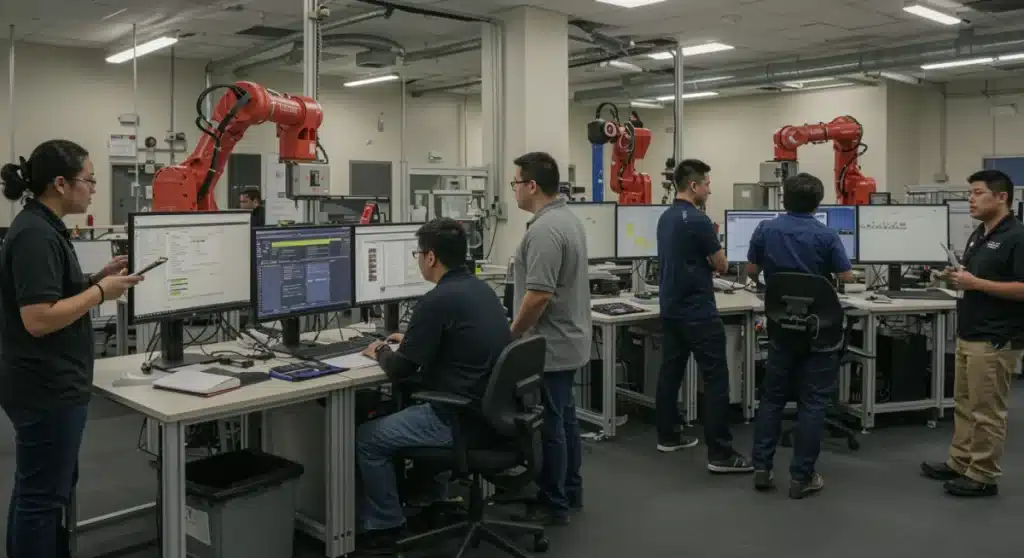
This certification program is meticulously designed to provide students with a comprehensive understanding of robotic systems, automated production lines, and the principles of Industry 4.0. It combines theoretical knowledge with extensive practical experience, ensuring graduates are proficient in troubleshooting, maintenance, and programming complex machinery.
Curriculum highlights and industry partnerships
The curriculum for the Advanced Manufacturing and Robotics Technician Certification is built around core competencies identified by leading manufacturing firms. Students will delve into topics such as:
- Robotics programming and operation
- Industrial automation and control systems
- Computer-aided design (CAD) and manufacturing (CAM)
- Predictive maintenance and data analytics
Crucially, the program includes mandatory internships with local manufacturing companies. These partnerships provide invaluable real-world experience, allowing students to apply their learning in authentic industrial settings and build professional networks before graduation. The colleges have secured agreements with major players in the automotive, aerospace, and consumer goods manufacturing sectors, guaranteeing relevant exposure.
This program represents a significant step forward in preparing a workforce capable of driving innovation and efficiency in modern manufacturing. It is a direct response to the call from industries for highly skilled technicians who can manage and optimize advanced production technologies.
Program 2: Renewable energy systems installation and maintenance
The second groundbreaking program focuses on the rapidly expanding renewable energy sector. As the nation shifts towards sustainable energy sources, the demand for skilled professionals capable of installing, maintaining, and repairing these systems is skyrocketing.
This comprehensive program will train students to work with solar photovoltaic arrays, wind turbines, geothermal systems, and battery storage solutions. It emphasizes safety protocols, regulatory compliance, and efficient operational practices, preparing graduates for diverse roles in the green economy.
Addressing the climate crisis through skilled labor
The transition to renewable energy is not just an environmental imperative; it’s also a massive economic opportunity. This program is designed to capitalize on that opportunity by creating a workforce ready to tackle the challenges of climate change head-on. Students will gain expertise in:
- Solar panel installation and troubleshooting
- Wind turbine mechanics and electrical systems
- Energy storage technologies
- Grid integration and smart energy management
Community colleges are collaborating with utility companies, renewable energy developers, and environmental organizations to ensure the curriculum is aligned with current industry standards and future trends. This collaborative approach means students are learning the most up-to-date techniques and technologies, making them highly desirable candidates upon completion.
Graduates of this program will play a crucial role in building out the nation’s renewable energy infrastructure, contributing to energy independence and environmental sustainability. It’s a forward-thinking initiative that meets both economic and ecological needs.

Program 3: Cybersecurity and data privacy specialist
In an increasingly digital world, cybersecurity and data privacy have become paramount concerns for businesses and individuals alike. The third innovative program, launching in 2026, aims to address the critical shortage of cybersecurity professionals.
This specialist program will equip students with the knowledge and practical skills to protect digital assets, identify and mitigate cyber threats, and ensure compliance with data privacy regulations. It covers a broad spectrum of topics from network security to ethical hacking and incident response.
Protecting digital assets in an interconnected world
The threats in the cyber realm are constantly evolving, requiring a workforce that is not only skilled but also adaptable and continuously learning. This program delves into key areas such as:
- Network security and infrastructure protection
- Ethical hacking and penetration testing
- Digital forensics and incident response
- Data privacy laws and regulations (e.g., CCPA, HIPAA)
Community colleges are partnering with cybersecurity firms, government agencies, and corporate IT departments to offer students access to real-world case studies, simulated cyberattack scenarios, and mentorship opportunities. These collaborations ensure the curriculum is always current and reflective of the latest threats and defense strategies.
Graduates will be prepared for roles such as cybersecurity analysts, security engineers, and data privacy officers, positions that are in extremely high demand across nearly every industry. This program is essential for safeguarding our digital future and protecting sensitive information.
Impact on students and local economies
These innovative programs extend far beyond individual career pathways; they represent a significant investment in the economic vitality of local communities. By training a skilled workforce, community colleges are directly supporting regional industries and attracting new businesses.
For students, these programs offer clear, accelerated paths to well-paying jobs in growing sectors. Many of these certifications can be completed in a shorter timeframe than traditional associate’s degrees, allowing individuals to enter the workforce more quickly and begin earning a competitive salary.
Fostering economic growth and social mobility
Community colleges play a crucial role in promoting social mobility by providing affordable access to education and training that leads to better economic outcomes. These specialized programs are particularly effective because they:
- Reduce student debt by offering shorter, focused training.
- Increase earning potential in high-demand fields.
- Provide opportunities for career advancement and lifelong learning.
Furthermore, by collaborating closely with local businesses, colleges ensure that the training provided is directly relevant to the needs of the employer. This creates a virtuous cycle where businesses have access to a skilled talent pool, and students have clear employment prospects. The economic ripple effect benefits the entire community through increased consumer spending, local tax revenues, and overall prosperity.
The success of these programs relies on continued collaboration between educational institutions, government bodies, and private industry. This synergy ensures that community colleges remain responsive, relevant, and indispensable to the nation’s economic health and individual well-being.
Future outlook: continuous adaptation and innovation
The launch of these three programs in 2026 is not an endpoint, but rather a testament to the ongoing commitment of U.S. community colleges to continuous adaptation. The pace of technological change and market demands dictates that educational institutions must remain agile and forward-thinking.
Looking ahead, community colleges are already exploring new fields such as artificial intelligence ethics, advanced biotechnology, and sustainable urban planning. Their strategy involves constant dialogue with industry leaders, labor market analysis, and a willingness to quickly develop and deploy new training modules.
Preparing for the next wave of workforce needs
The future of work will undoubtedly bring new challenges and opportunities. Community colleges are preparing for this by:
- Investing in flexible learning platforms and simulation technologies.
- Expanding apprenticeship and work-based learning models.
- Developing stackable credentials that allow students to progressively build skills.
Their ability to offer modular, competency-based education means students can acquire specific skills as needed, rather than committing to lengthy traditional degree programs. This micro-credentialing approach is particularly valuable in fast-evolving sectors where continuous skill upgrades are essential.
The proactive stance of U.S. community colleges ensures they will continue to be the backbone of workforce development, empowering individuals and strengthening the national economy for decades to come. Their innovative spirit is crucial for navigating the complexities of the modern global marketplace.
| Key Program | Workforce Demand Addressed |
|---|---|
| Advanced Manufacturing & Robotics | Need for skilled technicians in automated production and Industry 4.0. |
| Renewable Energy Systems | Growing demand for installation and maintenance of green energy infrastructure. |
| Cybersecurity & Data Privacy | Critical shortage of professionals protecting digital assets and ensuring data compliance. |
Frequently asked questions about community college workforce programs
Community colleges excel due to their strong local industry ties, allowing them to quickly identify skill gaps and design relevant programs. Their flexible structure enables rapid curriculum development, ensuring graduates possess up-to-date, in-demand skills for immediate employment.
By training a specialized workforce, these programs directly support regional industries and attract new businesses. This leads to increased local employment, higher wages, and a stronger economic base, fostering overall community prosperity and growth.
Yes, each program targets distinct, high-demand career fields. For instance, the Advanced Manufacturing program prepares robotics technicians, while the Renewable Energy program trains solar and wind system specialists, offering clear pathways to specific job roles.
Students receive extensive practical training through state-of-the-art labs, simulations, and mandatory internships with industry partners. This ensures they acquire not just theoretical knowledge but also the tangible, real-world skills essential for job success.
These programs directly address the skill gap by aligning curricula with employer needs, offering industry-recognized certifications, and providing specialized training in emerging fields. This ensures graduates possess the precise skills required by today’s and tomorrow’s employers.
Conclusion
The proactive development and launch of these three innovative programs in 2026 underscore the critical role U.S. community colleges play in shaping the nation’s workforce. By directly responding to evolving industry demands in advanced manufacturing, renewable energy, and cybersecurity, these institutions are not only equipping students with vital skills for future careers but also bolstering local economies. Their commitment to adaptability and strong industry partnerships ensures a continuous supply of skilled professionals, driving innovation and sustainable growth across the country.
