
K-12 Curriculum Standards 2026: A State-by-State Guide to Education Reform

Anúncios
K-12 Curriculum Standards 2026: A State-by-State Guide to Education Reform
The landscape of K-12 education in the United States is in a perpetual state of evolution, driven by societal needs, technological advancements, and a deeper understanding of learning processes. As we approach 2026, educators, policymakers, parents, and students alike are bracing for significant shifts in K-12 curriculum standards across various states. These changes are not merely minor adjustments; they represent a concerted effort to recalibrate educational priorities, ensuring that students are not only well-versed in foundational knowledge but also equipped with the critical thinking, problem-solving, and adaptability skills essential for the 21st century. This comprehensive guide will delve into the anticipated K-12 curriculum standards for 2026, offering a detailed, state-by-state breakdown of the proposed changes, their potential impact, and strategies for navigating this evolving educational environment.
Understanding these upcoming new K-12 standards is crucial for all stakeholders. For students, it means new learning objectives and assessment methods. For teachers, it necessitates professional development and pedagogical adjustments. For parents, it requires staying informed to support their children effectively. And for the broader community, it reflects a collective investment in the future workforce and citizenry. This article aims to demystify these changes, providing clarity and actionable insights.
Anúncios
The National Drive for Evolving K-12 Curriculum Standards
Before diving into state-specific details, it’s important to understand the broader context driving these national shifts in K-12 education reform. Several factors contribute to the ongoing re-evaluation of curriculum standards:
Anúncios
- Global Competitiveness: The need for U.S. students to compete on a global stage in STEM fields, innovation, and critical thinking.
- Workforce Demands: The rapidly changing job market requires skills beyond traditional rote learning, emphasizing creativity, collaboration, and digital literacy.
- Equity and Access: Efforts to ensure all students, regardless of socioeconomic background or geographic location, have access to high-quality education that prepares them for success.
- Technological Integration: The pervasive influence of technology necessitates its effective integration into the curriculum, not just as a tool, but as a subject of study and a means for deeper learning.
- Social-Emotional Learning (SEL): A growing recognition of the importance of emotional intelligence, resilience, and interpersonal skills in student development and future success.
- Evidence-Based Practices: A commitment to incorporating research-backed pedagogical approaches that demonstrate effectiveness in student outcomes.
These overarching themes often manifest in state-level decisions, leading to a mosaic of approaches to curriculum updates. While some states might focus heavily on STEM, others might prioritize literacy or civic education. The common thread, however, is a desire to improve educational outcomes and relevance for the 21st century student.
Key Trends in 2026 K-12 Curriculum Standards
As states roll out their new 2026 education standards, several key trends are emerging across the nation:
Emphasis on Deeper Learning and Conceptual Understanding
Many states are moving away from a mile-wide, inch-deep approach to content coverage. Instead, the focus is shifting towards deeper learning, where students engage with fewer topics but explore them in greater depth. This encourages conceptual understanding, critical thinking, and the ability to apply knowledge in novel situations, rather than merely memorizing facts. This impacts all subjects, from mathematics to humanities, promoting a more integrated and meaningful learning experience.
Increased Focus on STEM and Computer Science
The demand for STEM professionals continues to grow, and states are responding by bolstering their science, technology, engineering, and mathematics curricula. This often includes earlier introduction to computer science concepts, coding, and computational thinking, preparing students for a tech-driven future. Some states are even making computer science a graduation requirement.
Enhanced Literacy Across All Subjects
Literacy is no longer confined to English Language Arts (ELA) classes. New K-12 curriculum standards emphasize reading, writing, and communication skills across all disciplines. This means science teachers will focus on scientific literacy, history teachers on historical analysis of texts, and so on. The goal is to cultivate students who can effectively read, interpret, and communicate complex information in any context.
Integration of Social-Emotional Learning (SEL)
Recognizing the vital role of emotional well-being and social skills, many states are embedding SEL competencies into their curricula. This includes teaching students about self-awareness, self-management, social awareness, relationship skills, and responsible decision-making. SEL is seen as foundational for academic success and overall life satisfaction.
Civic Education and Global Citizenship
In an increasingly interconnected world, and with growing discussions around civic engagement, there’s a renewed focus on civic education. This goes beyond memorizing historical dates to understanding democratic processes, civic responsibilities, and the principles of global citizenship. States are aiming to foster informed, engaged, and responsible citizens.
Personalized Learning and Differentiated Instruction
Technology allows for more personalized learning pathways, and new standards often encourage teachers to differentiate instruction to meet the diverse needs of students. This can involve adaptive learning software, project-based learning, and flexible grouping strategies to cater to individual learning styles and paces.
State-by-State Breakdown: Anticipated K-12 Curriculum Standards in 2026
While national trends provide a general direction, the specifics of state education standards vary considerably. Here’s a look at what some states are projected to implement or continue to refine by 2026:
California: Innovation and Equity in Learning
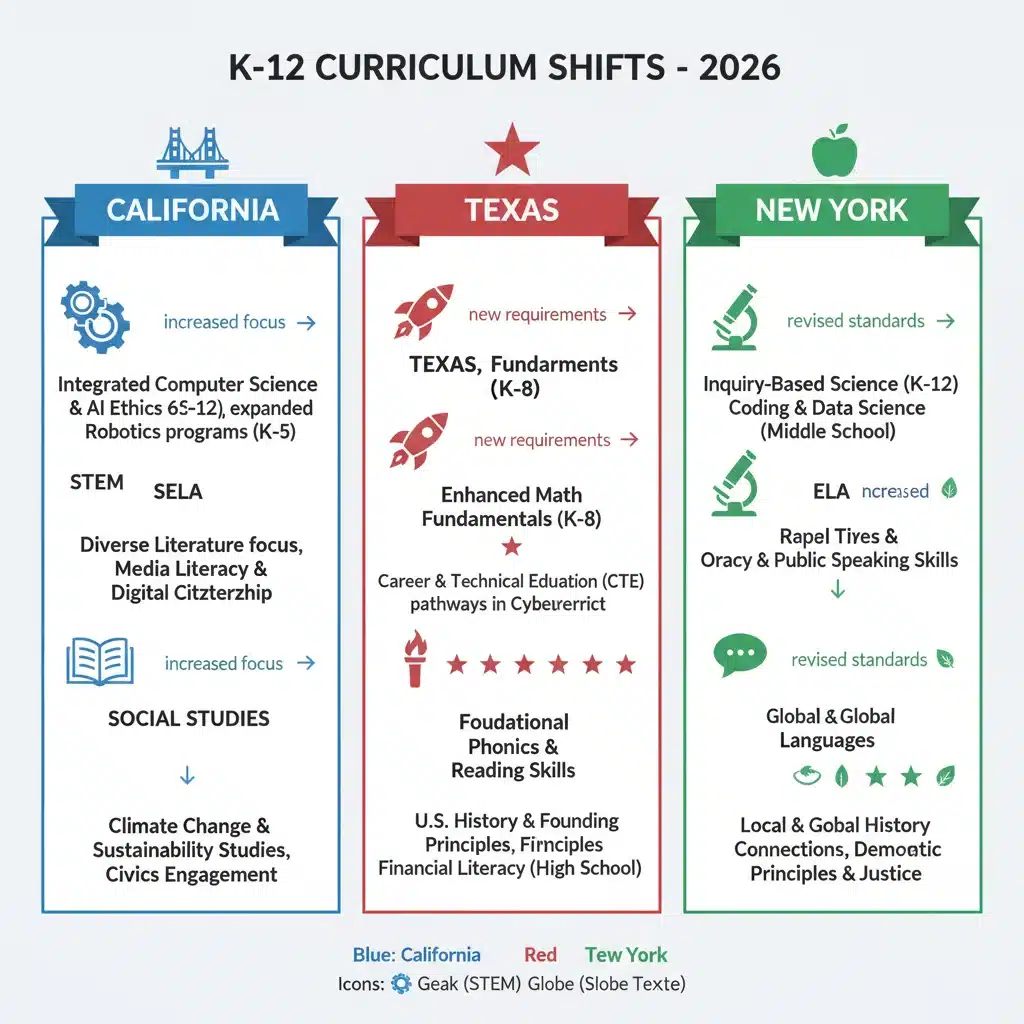
California is expected to continue its focus on robust STEM education, with an emphasis on environmental literacy and climate change education integrated across disciplines. There’s also a strong push for ethnic studies as a graduation requirement, aiming to provide students with a comprehensive understanding of diverse histories and cultures. The state is investing in professional development to support teachers in implementing these complex, interdisciplinary California K-12 standards. Equity remains a cornerstone, with initiatives to address achievement gaps and provide resources for underserved student populations, particularly in digital access and literacy.
Texas: Foundational Skills and Workforce Readiness
Texas generally emphasizes foundational academic skills and preparing students for college and career. For 2026, the state is likely to continue refining its Texas Essential Knowledge and Skills (TEKS) with a focus on strengthening early literacy and numeracy. There’s an ongoing push for career and technical education (CTE) pathways, ensuring students gain practical skills relevant to high-demand industries within the state. Science and mathematics standards may see updates to align with technological advancements and industry needs, with a pragmatic approach to Texas curriculum changes.
New York: Critical Thinking and Global Perspectives
New York’s education system often prioritizes critical thinking, comprehensive ELA standards, and a global perspective. Anticipated changes for 2026 may include further integration of civics and global studies, encouraging students to analyze complex societal issues. There’s also a strong emphasis on arts education as integral to a well-rounded curriculum. The state is likely to continue its efforts in supporting diverse learners, including multilingual students and those with disabilities, ensuring equitable access to rigorous K-12 curriculum standards.
Florida: Parental Rights and Foundational Knowledge
Florida has been a focal point for discussions around parental rights in education and foundational knowledge. By 2026, the state is expected to reinforce curricula that emphasize civics, American history, and traditional academic subjects. There may be continued scrutiny on instructional materials and a focus on ensuring content aligns with state-defined values. Early literacy initiatives, particularly phonics-based instruction, are likely to remain a high priority, aiming to build strong reading skills from an early age under the Florida K-12 standards framework.
Illinois: Holistic Development and Career Pathways
Illinois is often characterized by a progressive approach to education, including a strong emphasis on social-emotional learning (SEL) and comprehensive health education. For 2026, the state may further integrate SEL competencies across all grade levels and subject areas. There’s also a focus on expanding career pathways and dual enrollment opportunities, allowing students to earn college credit or industry certifications while still in high school. The state continues to work towards equitable funding and resources to support these Illinois curriculum updates across all districts.
Ohio: Readiness for College and Career
Ohio’s educational goals typically center on preparing students for success in college and various careers. The state’s K-12 curriculum standards for 2026 are likely to continue refining its academic content standards, with a strong focus on mathematics and English language arts. There’s an ongoing effort to strengthen partnerships between schools and local businesses to create relevant work-based learning experiences. Digital literacy and critical thinking skills are also high priorities, ensuring students can navigate the modern information landscape effectively.
Massachusetts: Academic Rigor and Innovation
Massachusetts consistently ranks high in educational achievement, known for its rigorous academic standards. For 2026, the state is expected to maintain its high expectations, potentially exploring advanced placement (AP) for all initiatives and further integrating cutting-edge research into its science and mathematics curricula. There’s a strong emphasis on fostering innovation and creativity, encouraging schools to experiment with new pedagogical approaches that enhance student engagement and outcomes. The state’s commitment to supporting high-quality teacher development is also a constant, ensuring educators are well-prepared for any Massachusetts standards revisions.
Other States and Emerging Patterns
Many other states are also undergoing significant reviews and revisions. For example:
- Arizona may focus on bolstering civics education and ensuring a strong foundation in reading and math.
- Georgia is likely to continue its push for STEM education and career readiness, with an eye towards industry partnerships.
- Washington often emphasizes environmental education and digital citizenship within its K-12 curriculum standards.
- Pennsylvania may focus on strengthening early childhood education and ensuring smooth transitions between grade levels.
- North Carolina is frequently reviewing its standards to ensure alignment with national best practices while also addressing specific state needs, particularly in science and social studies.
It is imperative for stakeholders in each state to consult their respective Department of Education websites for the most current and detailed information regarding 2026 curriculum updates. These state-specific pages will provide timelines, resources, and often, opportunities for public input.
Impact of New K-12 Curriculum Standards on Students
The primary beneficiaries, and indeed the central focus, of these K-12 curriculum standards changes are the students. The impact will be multifaceted:
- Enhanced Skill Development: Students will likely develop stronger critical thinking, problem-solving, and communication skills, moving beyond rote memorization.
- Greater Engagement: With a focus on deeper learning, project-based activities, and relevant real-world applications, students may find learning more engaging and meaningful.
- Improved Readiness: The updated standards aim to better prepare students for college, vocational training, and the demands of a dynamic workforce.
- Increased Equity: Many reforms are designed to provide more equitable learning opportunities, addressing historical disparities and ensuring all students have access to rigorous content.
- Social-Emotional Growth: The integration of SEL can lead to more resilient, empathetic, and self-aware individuals, better equipped to navigate personal and social challenges.
- Potential for Adjustment Challenges: Some students, especially those accustomed to older learning styles, might require time and support to adapt to new instructional methods and assessment types.
Ultimately, the goal is to cultivate well-rounded individuals who are not only academically proficient but also socially conscious, emotionally intelligent, and prepared for lifelong learning.
Implications for Teachers and Educators
Teachers are at the forefront of implementing these new K-12 curriculum standards, and the changes will have significant implications for their professional practice:
- Professional Development: Extensive and ongoing professional development will be crucial to equip teachers with the knowledge and strategies needed to teach new content and pedagogical approaches.
- Curriculum Adaptation: Teachers will need to adapt existing lesson plans, create new instructional materials, and integrate technology more effectively into their teaching.
- Assessment Redesign: New standards often come with new assessment methods, moving towards more authentic, performance-based tasks that measure deeper understanding.
- Collaboration: Increased collaboration among teachers, across grade levels and subject areas, will be essential to ensure vertical and horizontal alignment of the curriculum.
- Advocacy and Input: Educators have a vital role to play in providing feedback on the implementation process, ensuring that the standards are practical and effective in the classroom.
- Increased Workload (Initially): The initial phase of adaptation can be demanding, requiring significant time and effort from teachers to understand and implement the changes effectively.
Support from school districts, state departments of education, and professional organizations will be paramount in ensuring teachers feel empowered and prepared, rather than overwhelmed, by these changes. Investment in high-quality, sustained professional learning opportunities is non-negotiable for successful implementation of teacher impact standards.
Guidance for Parents and Guardians
Parents and guardians play a critical role in supporting their children through educational transitions. Understanding the new K-12 curriculum standards is key:
- Stay Informed: Regularly check your school district’s website and attend parent-teacher conferences to understand the specific changes affecting your child’s grade level and subjects.
- Communicate with Teachers: Establish open lines of communication with your child’s teachers to discuss learning objectives, progress, and any challenges.
- Support Learning at Home: Create a supportive home learning environment. This doesn’t mean teaching the new curriculum yourself, but rather fostering a love of learning, providing resources, and encouraging critical thinking through everyday activities.
- Advocate for Your Child: If you notice your child struggling, don’t hesitate to reach out to school staff for additional support or resources.
- Understand New Assessment Methods: Familiarize yourself with how your child will be assessed, as it may differ from traditional tests.
- Encourage Skills Beyond Content: Focus on developing skills like problem-solving, resilience, and curiosity, which are foundational to navigating any new curriculum.
Active parental engagement can significantly ease the transition for students and reinforce the learning objectives established by the parent guide curriculum.
Challenges and Opportunities in Implementing New K-12 Curriculum Standards
Implementing widespread changes to K-12 curriculum standards is rarely without its hurdles, but it also presents significant opportunities:
Challenges:
- Funding: Adequate funding for professional development, new materials, and technological infrastructure is often a major obstacle.
- Teacher Buy-in and Training: Ensuring all teachers are on board and sufficiently trained requires careful planning and resources.
- Resistance to Change: Some stakeholders may resist new approaches, preferring established methods.
- Assessment Alignment: Developing assessments that truly measure the intended learning outcomes of new standards can be complex and time-consuming.
- Equity Gaps: Without careful implementation, new standards could inadvertently widen existing equity gaps if resources and support are not distributed fairly.
Opportunities:
- Innovation in Teaching: New standards can inspire teachers to explore innovative pedagogical practices and integrate technology creatively.
- Improved Student Outcomes: If effectively implemented, the changes have the potential to significantly enhance student learning, engagement, and readiness for the future.
- Strengthened Community Partnerships: The need for broad support can foster stronger collaborations between schools, families, businesses, and community organizations.
- Professional Growth for Educators: The transition provides a chance for educators to expand their skills, knowledge, and leadership capacities.
- Modernized Education System: These reforms offer an opportunity to create a more relevant, dynamic, and responsive education system that meets the demands of the 21st century.
Addressing these challenges proactively and leveraging the opportunities effectively will be key to the successful adoption of the education reform challenges and ensuring a positive impact on student learning.
Preparing for the Future of K-12 Education
As 2026 draws nearer, preparation for the new K-12 curriculum standards should be a priority for all involved. This includes:
- For Policymakers: Ensuring clear communication, providing adequate funding, and establishing robust support systems for districts and schools.
- For School Leaders: Developing comprehensive implementation plans, fostering a culture of continuous learning, and advocating for necessary resources.
- For Teachers: Actively participating in professional development, collaborating with colleagues, and maintaining an open mind to new instructional strategies.
- For Parents: Staying informed, engaging with the school community, and supporting children’s learning journey at home.
- For Students: Approaching new learning experiences with curiosity and a willingness to adapt, embracing the opportunity to develop new skills.
The evolution of K-12 education is a continuous process, and the 2026 curriculum standards represent another significant step in that journey. By understanding the changes, embracing the opportunities, and addressing the challenges collaboratively, we can ensure that the next generation of students is well-prepared for a future that is constantly innovating.
Conclusion
The impending K-12 curriculum standards for 2026 mark a pivotal moment in American education. From California’s focus on environmental literacy and ethnic studies to Texas’s emphasis on foundational skills and workforce readiness, each state is charting its unique course while often aligning with national trends towards deeper learning, STEM integration, and social-emotional development. These changes reflect a collective ambition to equip students with the knowledge, skills, and dispositions necessary to thrive in an increasingly complex and interconnected world.
While the transition will undoubtedly bring challenges for educators, students, and parents, it also presents an unparalleled opportunity to modernize our education system, foster innovation in teaching, and ultimately, enhance student outcomes across the board. By staying informed, engaging actively in the process, and committing to collaborative efforts, all stakeholders can contribute to the successful implementation of these vital education reforms 2026. The future of K-12 education is bright, and with these new standards, we are collectively laying the groundwork for a generation of learners prepared to tackle the challenges and seize the opportunities that lie ahead.
